
'The government's priority is not farmers.'
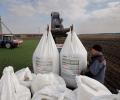
'China reduced its exports of urea to India gradually.' 'In 2020-2021 we imported 28 lakh tonnes of urea which reduced to 16 lakh tonnes in 2022-2023 and that has now reduced to 1 lakh tonnes in 2024-2025.'

Prime Minister Modi last week called for optimal grain storage, fire audits and mock drills in hospitals as preparations for the harsh summer forecast by the meteorological department.
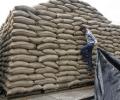
With grain procurement target significantly higher, FCI is faced with storage space shortage.

Industry associations and companies in the United States, including the US Chamber of Commerce, Coalition of Services Industries and the iconic bike company Harley Davidson have called on the Donald Trump dispensation to push India to reduce tariffs, non-tariffs, and regulatory barriers to boost American exports.

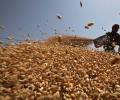
The wheat procurement season has ended in most big foodgrain-growing states with an all-time high purchase of almost 28 million tonnes (mt), creating a problem of storing such huge stocks.

India on Wednesday ruled out the need to import wheat this year, as it appears poised to surpass the 15 million tons procurement target. Agriculture and Food Minister Sharad Pawar said that the govt is confident of procuring 16-17 million tons of wheat this year. As per govt estimate wheat production was pegged at 76.78 million tons for 2007-08 crop year ending May this year. He noted that wheat price is stable due to ample availability backed by a bumper production.

If states have to fall in line with MSPs declared by political parties, they will have to do so in violation of central order or bear the full expense of the surplus procured at above MSP rates.

India's foodgrain requirement is expected to rise to around 61.2 million tonnes against the average procurement of last five years at 51.4 million tonnes.
The protesting farmers' main demand to legalise the minimum support price (MSP) regime has divided opinion. One school of thought says it would lead to crop diversification and help India keep under check its burgeoning import bill on edible oils and pulses, while another says it would incentivise farmers to produce low-quality crops. Contrary to popular perception, India has a trade surplus in agriculture and allied activities, which stood at $18.65 billion during 2022-23 (FY23) against $15.92 billion in the previous year. However, the surplus was mainly on account of rice, wheat, sugar, spices, and buffalo meat.
Still unsure of its ability to procure wheat from the market, the Centre has extended the tender dates for import of 1 million tonne wheat.

The move came a day after Parliament approved two agriculture sector-reform bills which have been bitterly opposed by the opposition parties like Congress and TMC.
India on Thursday fixed the price of wheat sold to exporters from this year's new crop at Rs 5,550 ($118.4) a tonne, a government statement said.
Worried over its failed procurement operations and anticipating a shortfall in production, the Centre has decided to invite tenders for import of 1 million tones of wheat.
This is bound to create more trouble for the Centre on the wheat front.
In Uttar Pradesh, it seems, there are no takers for the government agencies as far as wheat collection is concerned.
However, storage capacity way behind even present public distribution system procurement need.

Finance Minister is unhappy over lack of storage capacity.

India is expected to harvest 291.95 mt of foodgrain in 2019-20
The decision to increase the MSPs (Minimum Support Prices) was taken at a meeting of the Cabinet Committee on Economic Affairs (CCEA) chaired by Prime Minister Narendra Modi. MSP is the rate at which the government buys the grain from farmers. Currently, the government fixes MSPs for 23 crops grown in both kharif and rabi seasons. Sowing of rabi (winter) crops begins from October immediately after the harvest of kharif (summer) crops.
Ingenious farmers in Punjab have decided to hold on to their wheat till the market is ready to offer them better prices.
As part of steps to control inflation and augment availability of essential commodities, the government is considering re-allocating wheat in place of rice for the Targeted Public Distribution System (TPDS) and other welfare schemes.

The finance ministry on Thursday raised concerns over the possible impact of El Nio conditions on India this year, saying if recent forecasts came true, the country could see lower agricultural output and higher inflation. "Some meteorological agencies predict the return of El Nio conditions in India this year. "If these predictions are accurate, then monsoon rains could be deficient, leading to lower agricultural output and higher prices," the ministry said in its monthly economic review.
The UPA government will fulfill the Congress promise of providing rice and wheat at cheap rates through ration shops in the wake of record procurement by the state agencies, Agriculture and Food Minister Sharad Pawar said on Monday after taking charge.

The stock of Mahindra & Mahindra (M&M) has been touching successive all-time highs on the bourses and, over the past year, gained 81 per cent. While the S&P BSE Auto Index has not performed poorly, registering gains of 73 per cent, it still trails the company by 800 basis points (bps) during this period. There are multiple reasons why investors are beating a path to M&M's counter.

Apart from the human body, human food will bear direct repercussions. From staples such as wheat, to coffee, dairy, and even the great Hilsa face the threat of reduced supply due to the extreme heat.
More important is to diversify the country's farm production base.

Farmers said a big reason for the anger was the sudden stopping of wheat procurement by the state government in some places, which had caused the prices to dip below the minimum support price.

The govt said Rs 30,729 crore was required for waiving loans of small and marginal farmers.
The downward trend in prices might continue as demand is unlikely to recover in May. Moreover, increased production has also put pressure on prices of commodities.

ITC will also launch paneer shortly and is also working on cheese and Tetra Pak milk

Is it a case of poor targeting of a welfare scheme, or is it a reflection of the government's desire to expand the scope of this benefit to secure greater electoral dividends? asks A K Bhattacharya.

In the coming few weeks, agriculture markets in North and Central India will be full of wheat, mustard, and chana - the three main rabi crops grown in these parts. Not only will the price trajectory of these determine the course of food inflation in the months to come, but it could also have a wider impact on the rural economy in the main growing states for these crops. Wheat and chana are largely grown in Madhya Pradesh (MP).

'They just say we agree to your demands in the meetings, which is lip service. But on the ground they do not implement anything.'
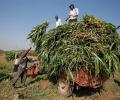
India achieved record foodgrains production this year but the withdrawal of three agri-reform laws and spike in cooking oil prices cast a shadow on the country's resilient agriculture sector that is on course for better harvest in 2022 despite pandemic blues. While soaring production of foodgrains that also helped the government provide free additional rations for COVID-hit poor families for many months together came as a relief, the passing year will be remembered for the long drawn farmers' protest at Delhi borders against the three laws and subsequent repeal of the legislations. The Indian agriculture sector, which was among the few segments that remained robust amid the pandemic gales, is expected to register a growth rate of 3.5 per cent in the current financial year ending March 2022.

Loan waivers will never be enough. Reforming the agricultural marketing system is essential to addressing the concerns of farmers in a sustainable manner, says Nitin Desai.

Most key rabi-producing states of north India, such as Madhya Pradesh and Rajasthan, have staggered their procurement to enable farmers to come in batches, so that there is no overcrowding. The Centre has also set up a call centre to coordinate the inter-state movement of farm commodities.

'While every year presents new challenges, it also provides opportunities for better growth and performance.'

Few finance ministers announce any taxation measure that could upset the stock market. Ms Sitharaman decided to take that risk, observes A K Bhattacharya.
'We cannot afford to be complacent about our food security needs.'
